
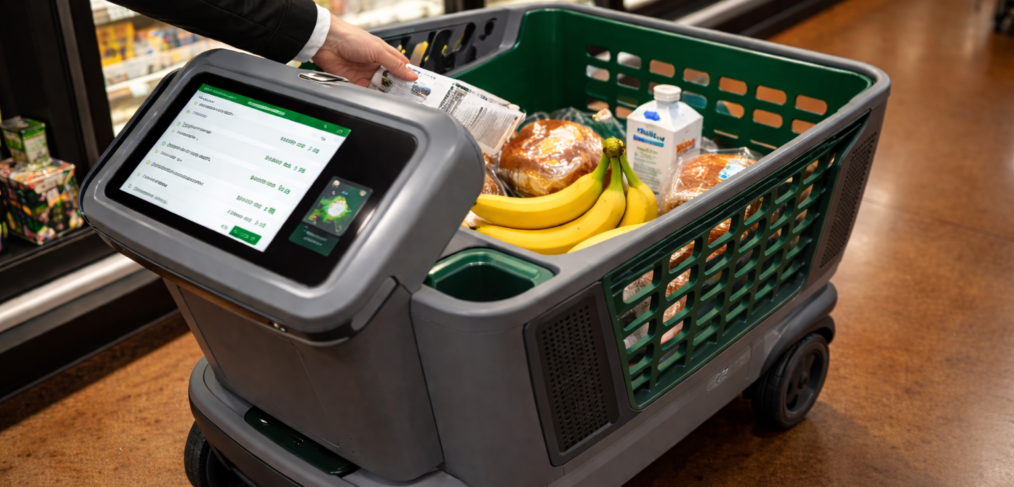
How AI Is Retooling Consumer Grocery Shopping


How a simple task such as grocery shopping has evolved. In the 1960s, my mother was responsible for grocery shopping. The only grocery store available was our local Dominion.
1960’s Dominion Flyer

Special thank you to Jim Slomka
Historically, cashiers manually entered the price of each item at checkout. This changed in July 1974 when the Universal Product Code debuted at a Steinberg grocery store in Dorval, Quebec, making Canada the second country in the world to adopt this technology. Consumers primarily paid with cash or by check. It was not until the early 90’s that the credit card was introduced.
Grocery shopping has undergone a massive transformation since then. From neighborhood shopping to “one-stop” supercenters, online orders, and self-checkout, with the “one-stop” model itself now evolving due to cost-conscious, multi-retailer shopping. The first “No Frills” store opened on July 5th, 1978, to combat inflation in East York, Toronto, Ontario. Today, consumers have become more empowered than ever before through technologies that help them look behind the curtain, become more well informed, and understand the products and the ingredients utilized in the items they wish to purchase. The average consumer uses 8 ways (buy buttons on their social media platforms) to find a deal and make a purchase.[1]
In 2025, life as we know it has been transformed by AI. Over the past year, 45% of Canadians have incorporated AI into their shopping journeys.[2]
How AI is Retooling Consumer Grocery Shopping!
“Artificial intelligence (AI) is technology that enables computers and machines to simulate human learning, comprehension, problem solving, decision making, creativity, and autonomy”[3].
Unlike traditional software, AI can learn from experience and adjust to new inputs. AI offers numerous benefits across various industries and applications. Frequently mentioned advantages include:
- More and faster insight from data. 2. Enhanced decision-making.3. Fewer human errors.
How is AI Reshaping Retailers?
AI may be invisible, yet it is becoming a central figure in retailers’ operations. As noted by Bruce Winder, President, Bruce Winder Retail, “AI is a “significant gamechanger” for the grocery sector for two key reasons:
- “One is that the grocery industry is low margin, and one of the benefits that AI offers is operational efficiency. Applications such as supply chain forecasting and replenishment can save real money in an industry that’s low margin.”
- “The ability (it gives retailers} to engage with customers at a deeper level, which increases sales and margins”[4]
Loblaws is aggressively integrating AI to revolutionize its retail operations, focusing on hyper-personalized customer experiences, supply chain optimization, and autonomous, driverless deliveries in Ontario. South of the border, Walmart rolled out its AI-generated assistant called “Sparky”, which will provide customers with the power to automatically reorder household essentials.
Is the Traditional Grocery Cart Becoming Obsolete?
The Traditional Grocery Cart Instacart Caper Cart
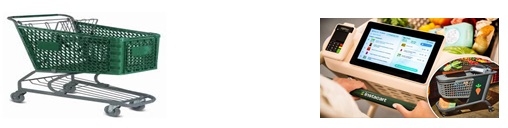
Are the days of having to scribble down must-gets like eggs, milk, and butter from the grocery store gone? Does AI have the list? Grocery stores in the tri-state (the metropolitan region surrounding New York City) began rolling out Instacart Caper Carts, grocery wagons powered by science. Outfitted with an LED touch screen, sensors, and cameras, the cart identifies, scans, weighs, and calculates the cost of each item placed inside its carriage. In addition, “ShopRite” shoppers can enter their “price plus” membership numbers into the on-cart computer to upload digital coupons, discover weekly discounts, and get recommended deals. Anti-theft software recently helped a grocery chain spot a shoplifter who allegedly swiped $5,000 in goods.[5]
How is AI Changing Grocery Shopping?
The AI revolution is already reshaping how consumers shop, as reported by Acosta Group.
“Our research confirms that AI is transforming the way consumers shop, and consumers are embracing AI in grocery shopping faster than in any other category,”
Kathy Risch, SVP of Shopper Insights and Thought Leadership at Acosta Group.
Generative AI tools are becoming the new gatekeepers of the shopper journey. Their study revealed:
- 70% of shoppers have used at least one AI tool or feature to assist with shopping.
- 53% of Gen Z AI-users find generative AI more trustworthy than traditional sources.
- 36% of shoppers have used AI tools for grocery tasks like researching and buying.[6]
Consumers are asking AI for recommendations, and many find it easier than sifting through Google’s ads. Here are the top three reasons people choose to use AI:
- Price Comparison: (71%) – Identifying the best prices across the store.
- Meal Planning: (42%) – Using bots to create recipes based on pantry items.
- Automated Reordering: Utilizing AI to reorder household staples based on predictive, past consumption patterns.[7]
Consumer Segments Employing Artificial Intelligence in Grocery Shopping
Consumers who use AI for grocery shopping today are mostly motivated by efficiency, personalized experience, and budget management. CTV News reports:
- More than half of Canadian shoppers (51%) say they are open to using artificial intelligence to complete a purchase.
- 30% of Canadians say they are already using AI when they shop, up from 11 % the previous year.
- 45% of Gen Z and 44% of Millennials use AI when shopping[8].
Two additional consumer segments using AI:
- Budget-Conscious Consumers: Consumers managing rising food costs are turning to AI-powered tools to compare local flyers, track price trends, and generate budget-friendly meal plans.
- Online and Hybrid Shoppers: A significant portion of AI usage comes from consumers using retail apps (Instacart) to create AI-driven shopping lists, receive tailored product suggestions, and make, or automate, purchases.
By 2030, 40% of consumers expect to use AI for comparison shopping, with many expecting full automation of their routine purchases.[9]
Food Distribution Guy’s Final Thoughts
AI is changing the way consumers interact with brands. From hyper-personalized content (“the advanced practice of using real-time data, artificial intelligence (AI), and predictive analytics to deliver unique, context-specific experiences to individual customers”) to voice-activated shopping assistants, today’s consumers expect experiences that are dynamic, tailored, and seamless. This strategy is no longer optional for growth. McKinsey & Company reveals:
- Organizations excelling at personalization generate 40% more revenue than their peers.
- Conversely, 44% of consumers will abandon brands that fail to deliver relevant, individualized experiences.[10]
SEO strategist and marketing expert Joel Youngblood found:
- 3% of adults now choose ChatGPT over Google searches (23.1%) when shopping online.
- 75% of adults have used AI in the past six months. ChatGPT leads overall AI usage at 46.1%, followed by Google Gemini (22.8%) and Meta AI on Facebook (19.3%).[11]
I leave you with this final quotation:
“Artificial intelligence and generative AI may be the most important technology of any lifetime.”
Marc Benioff
References:
[1] The 2026 Consumer Outlook, Nielsen IQ, November 2025
[2] The New AI-Powered Grocery Store, www.canadiangrocer.com, May 2025
[3] What is Artificial Intelligence, www.ibm.com.
[4] The New AI-Powered Grocery Store, www.canadiangrocer.com, May 2205
[5] AI Has Taken Over Grocery Shopping, and Helping People Save Money Stealthily, www.nypost.com.
[6] Why AI is the New Grocery Gatekeeper, www.foodsinstitute.com, October 2025
[7] How Consumers Use AI, AI Overview, February 2026
[8] New Report Suggests Growing Acceptance of AI in Canadian Shopping Habits, www.ctvnews.ca, January 2026
[9] Which Consumer Group is Utilizing AI when Grocery Shopping, AI Overview, February 2026
[10] Hyper-Personalization at Scale with Wedia, www.wedia-group.com, January 2026
[11] Why AI is the New Grocery Gatekeeper, www.foodinstitute.com, October 2025